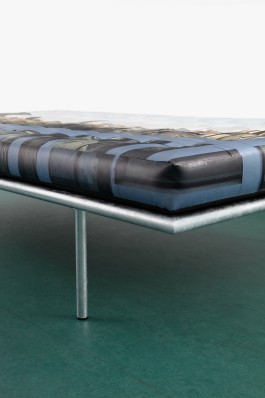


1/5 Berlin Bed #1, top view
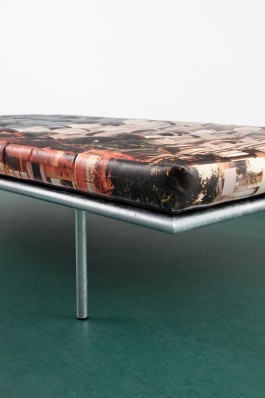
2/5 Berlin Bed #1, detail
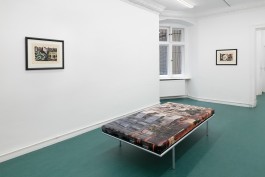
3/5 Berlin Bed #1 at Galerie Noah Klink
4/5 Berlin Bed #2, top view
5/5 Berlin Bed #2, detail
Berlin Bed, 2022
found printed advertisement tarp,
upholstery material, wood, galvanised steel
192 x 96 x 42 cm
In Berlin Bed #1 & #2 found and stolen tarps, known throughout cityscapes as displays for renderings of buildings in development, are used as an upholstery material for replicas of the Barcelona Bed by Mies van der Rohe.
The daybed, a piece of furniture for contemplation and rest, and due to its iconic design and author an accessory found itself in renderings and photographs used in the advertisement of real estate, becomes here a stage for the changing architectural landscape of Berlin.
The original rendering is cut and sewn into the square pattern of the upholstery, to display a fragmented, almost kaleidoscopic vision of this change.
In the exhibition Resting Visions they are used as benches from which the landscapes depicting a destroyed postwar Berlin by Werner Heldt can be viewed from.
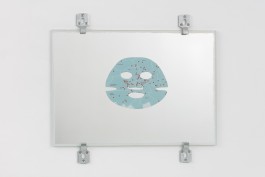
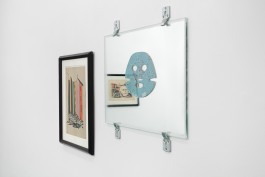
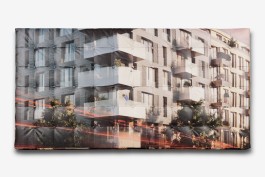
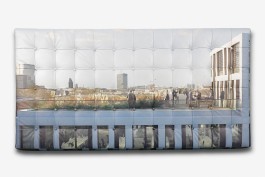
1/4 Exfoliating Treatment (Neubau Kompass #1)
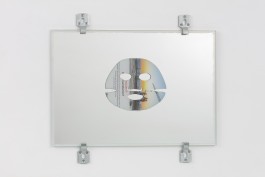
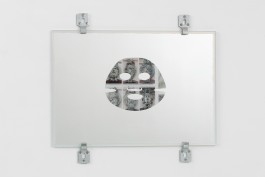
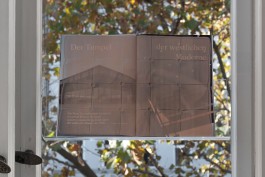
2/4 Exfoliating Treatment (E&V Advertisement #1)
3/4 Exfoliating Treatment (E&V Advertisement #1)
4/4 Exfoliating Treatment (Neubau Kompass #1) at Galerie Noah Klink
Exfoliating Treatment (Neubau Kompass #1), 2022
advertisment material (paper), glue, glass,
mirror, silicone, galvanised steel
45 x 65 cm
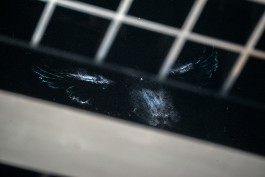
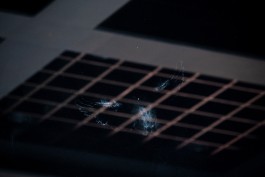
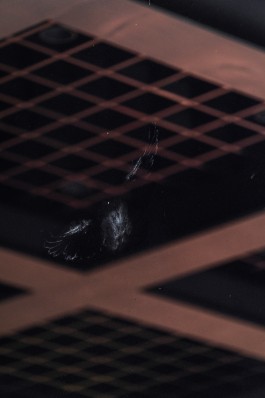
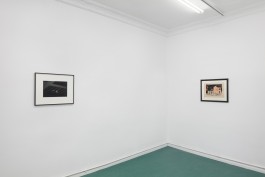
1/4 Bird in Space #1
2/4 Bird in Space #2
3/4 Bird in Space #4
4/4 Bird in Space #2 at Galerie Noah Klink
Bird in Space, 2022
c-print, mounted, framed
46 x 58 x 2 cm
Series of photographs depincting the impacts of bird on the windows of Neue Nationalgalerie in Berlin.
I was the shadow of the waxwing slain
By the false azure in the windowpane;
I was the smudge of ashen fluff - and I
Lived on, flew on, in the reflected sky.
From Pale Fire - V. Nabokov
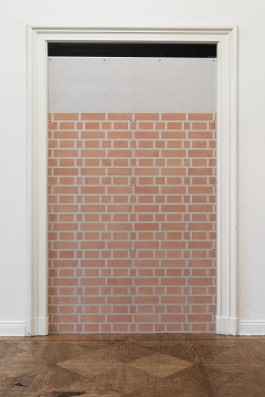
1/3 Brick pattern (rose beige; without shadow) at Angela Mewes, 2021
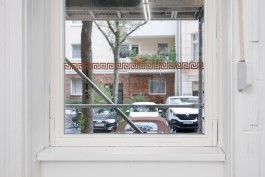
2/3 Lasting Foundation (24h window) Edition for Angela Mewes, 2021
3/3 Meander (soft sand) at Galerie Noah Klink, 2022
Brick pattern (rose beige; without shadow), 2021
Liquid foundation on plasterboard (or other exhibition space surface)
dimensions variable
Site-specific installation at Galerie Angela Mewes, Berlin
Brick pattern (rose beige; without shadow) is part of a series of works, that reproduces architectonical elements in two dimensions, here a brick wall, in fluid make-up on the walls and other surfaces of exhibition spaces. The make-up becomes here mediator between architecture and body, face and facade. The colour of make-up is primarily made up of iron-oxides, the same pigments that give bricks their distinctive colour. In this way the work point at how our built environment is part of the construction of a self-image, similarly to changing of the body and its appearance.
1/3 Brick pattern (rose beige; without shadow) at Angela Mewes, 2021
2/3 Lasting Foundation (24h window) Edition for Angela Mewes, 2021
3/3 Meander (soft sand) at Galerie Noah Klink, 2022


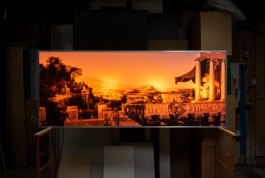
1/5 After Schinkel, in the Studio, on
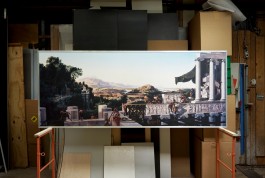
2/5 After Schinke, in the Studio, off
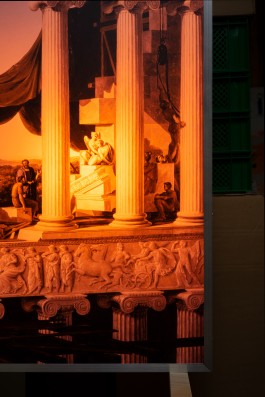
3/5 After Schinkel, detail
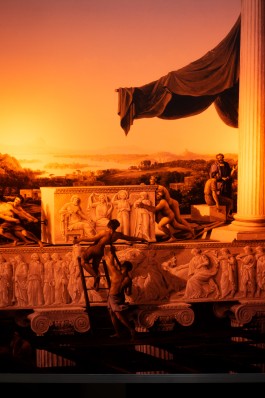
4/5 After Schinkel, detail
5/5 After Schinkel, detail
After Schinkel (Blick in Griechenlands Blüte, 1825), 2020
Latexprint on foil on acrylic, aluminum lightbox,
sodium-vapor lights, electrical equipment
238x97x15cm
In After Schinkel (Blick in Griechenlands Blüte, 1825) a full color reproduction of Karl Friedrich Schinkel‘s painting of the same name is set in a lightbox illuminated by the umpioriginal glow of Berlin streetlights: The lightbox is a snack bar standard in custom size, produced by a local berlin manufacturer. The lightbulbs are the ones used for streetlights in the city, in the same way that they mute color in the city, the light mutes and alters the painting by Schinkel.
The work overlaps a utopian vision of Berlin‘s future painted in 1825 with an idealized antique past. The universal artist Schinkel, Prussia‘s esthetic mastermind, had planned for Berlin to become an ‚Athens on the Spree‘. For the vandalism of time his plans have remained vision and only left traces in a Berlin that has become the arcadia of bright lights, big city.
Exhibited as Part of Studio Berlin at Berghain, Berlin
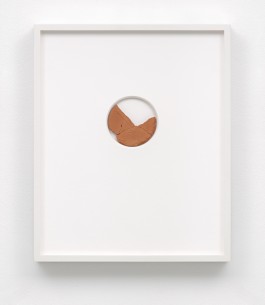
1/3 Foundation (African Erde - OG)
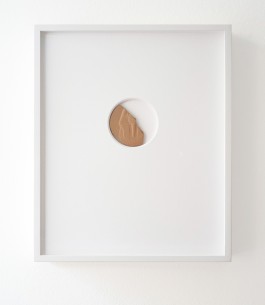
2/3 Foundation (Pharaon Earth #2)
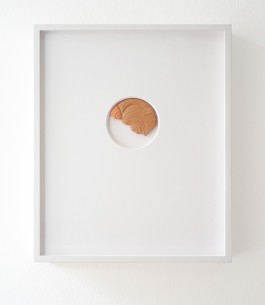
3/3 Foundation (pink cloud)
Foundation (African Erde - OG #2), 2019
Compact Powder, Museumcarton, Artists Frame
40x28x4cm
Broken fragments of ready made compact powder make up depicting sculptural motifs from antiquity, such as the profile of Nefertiti‘s bust, pharaoh masks and other geometric motifs. During the act of excavation from their plastic containers, the make up falls into pieces before being treated in a way to stabilise it in the state it is displayed.
In its resemblance to an archaeological object like a terracotta shard the mineral make-up cake reveals the fragile connection between self improvement and the creation of historical image and self image.

In Berlin Bed #1 & #2 found and stolen tarps, known throughout cityscapes as displays for renderings of buildings in development, are used as an upholstery material for replicas of the Barcelona Bed by Mies van der Rohe. The daybed, a piece of furniture for contemplation and rest, and due to its iconic design and author an accessory found itself in renderings and photographs used in the advertisement of real estate, becomes here a stage for the changing architectural landscape of Berlin.
The original rendering is cut and sewn into the square pattern of the upholstery, to display a fragmented, almost kaleidoscopic vision of this change. In the exhibition Resting Visions they are used as benches from which the landscapes depicting a destroyed postwar Berlin by Werner Heldt can be viewed from.


1/5 Berlin Bed #1, top view
2/5 Berlin Bed #1 (Detail)
3/5 Berlin Bed #1 at Galerie Noah Klink
4/5 Berlin Bed #2 (top view)
5/5 Berlin Bed #2 (Detail)
Berlin Bed
found printed advertisement tarp,
upholstery material, wood, galvanised steel
192 x 96 x 42 cm


1/4 Exfoliating Treatment (Neubau Kompass #1)
2/4 Exfoliating Treatment (E&V Advertisement #1)
3/4 Exfoliating Treatment (E&V Advertisement #1)
4/4 Exfoliating Treatment (Neubau Kompass #1) at Galerie Noah Klink
Exfoliating Treatment (Neubau Kompass #1), 2022
advertisment material (paper), glue, glass,
mirror, silicone, galvanised steel
45 x 65 cm

Series of photographs depincting the impacts of bird on the windows of Neue Nationalgalerie in Berlin.
I was the shadow of the waxwing slain
By the false azure in the windowpane;
I was the smudge of ashen fluff - and I
Lived on, flew on, in the reflected sky.
From Pale Fire - V. Nabokov


1/4 Bird in Space #1
2/4 Bird in Space #2
3/4 Bird in Space #4
4/4 Bird in Space #2 at Galerie Noah Klink
Bird in Space, 2022
c-print, mounted, framed
46 x 58 x 2 cm

Brick pattern (rose beige; without shadow) is part of a series of works, that reproduces architectonical elements in two dimensions, here a brick wall, in fluid make-up on the walls and other surfaces of exhibition spaces. The make-up becomes here mediator between architecture and body, face and facade. The colour of make-up is primarily made up of iron-oxides, the same pigments that give bricks their distinctive colour. In this way the work point at how our built environment is part of the construction of a self-image, similarly to changing of the body and its appearance.
1/3 Brick pattern (rose beige; without shadow) at Angela Mewes, 2021
2/3 Lasting Foundation (24h window) Edition for Angela Mewes, 2021
3/3 Meander (soft sand) at Galerie Noah Klink, 2022


1/3 Brick pattern (rose beige; without shadow) at Angela Mewes, 2021
2/3 Lasting Foundation (24h window) Edition for Angela Mewes, 2021
3/3 Meander (soft sand) at Galerie Noah Klink, 2022
Brick pattern (rose beige; without shadow), 2021
Liquid foundation on plasterboard (or other exhibition space surface)
dimensions variable

In After Schinkel (Blick in Griechenlands Blüte, 1825) a full color reproduction of Karl Friedrich Schinkel‘s painting of the same name is set in a lightbox illuminated by the umpioriginal glow of Berlin streetlights: The lightbox is a snack bar standard in custom size, produced by a local berlin manufacturer. The lightbulbs are the ones used for streetlights in the city, in the same way that they mute color in the city, the light mutes and alters the painting by Schinkel. The work overlaps a utopian vision of Berlin‘s future painted in 1825 with an idealized antique past. The universal artist Schinkel, Prussia‘s esthetic mastermind, had planned for Berlin to become an ‚Athens on the Spree‘. For the vandalism of time his plans have remained vision and only left traces in a Berlin that has become the arcadia of bright lights, big city. Exhibited as Part of Studio Berlin at Berghain, Berlin


1/5 After Schinkel, in the Studio, on
2/5 After Schinke, in the Studio, off
3/5 After Schinkel, detail
4/5 After Schinkel, detail
5/5 After Schinkel, detail
After Schinkel (Blick in Griechenlands Blüte, 1825), 2020
Latexprint on foil on acrylic, aluminum lightbox,
sodium-vapor lights, electrical equipment
238x97x15cm

Broken fragments of ready made compact powder make up depicting sculptural motifs from antiquity, such as the profile of Nefertiti‘s bust, pharaoh masks and other geometric motifs. During the act of excavation from their plastic containers, the make up falls into pieces before being treated in a way to stabilise it in the state it is displayed.
In its resemblance to an archaeological object like a terracotta shard the mineral make-up cake reveals the fragile connection between self improvement and the creation of historical image and self image.


1/3 Foundation (African Erde - OG)
2/3 Foundation (Pharaon Earth #2)
3/3 Foundation (pink cloud)
Foundation (African Erde - OG #2), 2019
Compact Powder, Museumcarton, Artists Frame
40x28x4cm